

RANCHI: As digital platforms become inseparable from everyday life, a quieter but consequential debate is gaining ground across democracies: whether social media growth must inevitably be tied to large-scale data profiling and behavioural tracking.
In this context, an Indian social platform, ZKTOR, introduced to the media in Ranchi this week, has drawn attention for framing privacy not as a compliance feature but as a systems-level design decision.
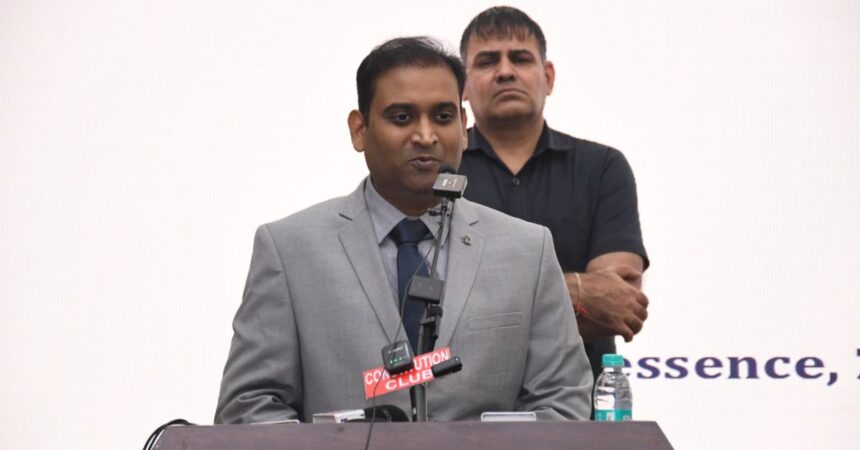
At a press interaction held in Ranchi, ZKTOR was presented by its architect and Softa Technologies’ CEO, Sunil Kumar Singh, who argued that the digital economy has reached a point where legal safeguards alone are no longer sufficient. According to him, privacy in the age of artificial intelligence must be embedded into the technical architecture itself, rather than enforced retrospectively through policies, user settings or content moderation mechanisms.
ZKTOR is positioned as an all-in-one Indian super-app, bringing together social networking, short-form video, long-form video and a fully encrypted messaging system within a single platform. What distinguishes its stated approach, however, is the emphasis on what it describes as “Privacy by Design”, a model where user data protection is determined by engineering constraints rather than discretionary access controls.
Central to this claim is ZKTOR’s Zero Knowledge Architecture. While most large platforms routinely process user content, behavioural signals and metadata at various layers of their systems, ZKTOR maintains that its servers are structured in a way that technically limits direct access to user content. The company asserts that even internal engineering teams cannot read or interpret user messages, images or videos. The premise, as outlined at the press briefing, is to reduce the scope for profiling, surveillance and commercial exploitation of personal data at the source.
More Read


This design philosophy takes on particular significance in the era of AI-driven content manipulation. With synthetic media and automated editing tools becoming widely accessible, the risk of misuse of photos and videos has escalated sharply, especially for women. ZKTOR’s response to this challenge is its No-URL content structure. By removing publicly shareable web links for uploaded media, the platform seeks to limit the ability to download, replicate or externally redistribute content.
According to Singh, the absence of URLs does not guarantee absolute immunity from misuse, but it significantly narrows the technical pathways through which content can be extracted and altered using AI tools. This approach reframes digital safety as a preventative design measure rather than a post-incident response mechanism, a departure from conventional reporting-and-takedown models.
Beyond privacy and safety, ZKTOR’s architecture also reflects a broader discussion around data sovereignty. The platform’s region-wise data handling and server infrastructure are intended to align with local legal and regulatory expectations. This design choice echoes ongoing policy debates in multiple jurisdictions about keeping citizens’ data within defined geographic and legal boundaries. ZKTOR’s proponents argue that such an approach naturally aligns with the spirit of India’s Digital Personal Data Protection framework as well as global regulations such as the EU’s GDPR, without treating compliance as an afterthought.

The platform’s narrative is closely tied to the background of its creator. Singh, who traces his roots to a small village in the Aurangabad region of what was once undivided Bihar and now has a long association with Jharkhand, spent over two decades working in Finland. At the briefing, he described ZKTOR as an attempt to combine Nordic principles of data protection, technical precision and social equality with the realities of Indian society, including rural connectivity, linguistic diversity and gender-based digital risks.
Equally notable is ZKTOR’s funding stance. Singh stated that the platform has been developed without accepting government grants from either India or Finland, and without raising foreign venture capital. The stated rationale is to insulate the platform’s technical direction from commercial pressures that often incentivise aggressive data monetisation. While ZKTOR has been described as aligned in spirit with Narendra Modi’s vision of a digitally self-reliant India by 2047, the company emphasised that no public funding or institutional backing has been involved in its development.
On the economic front, ZKTOR has outlined a monetisation framework that allocates a flat 70 percent share of earnings to content creators. In addition, its hyperlocal operational model is expected to generate roles related to moderation, community management and local platform operations, particularly in tier-2 to tier-4 cities. This, the company argues, connects digital platform growth with decentralised employment rather than concentrating value in a few metropolitan centres.
ZKTOR is currently available in beta across India, Nepal, Bangladesh and Sri Lanka, with mass testing underway in South Asia. Its presence on both Google Play Store and Apple App Store positions it alongside established global platforms, even as it questions the underlying assumptions that have shaped their growth.
Whether ZKTOR’s architecture-first approach can scale sustainably remains to be seen. What is clear, however, is that the platform has inserted a substantive question into the mainstream digital conversation: in an AI-driven world, should social media systems be designed primarily to observe and predict users, or to deliberately limit what they can see, infer and exploit.
For a debate often dominated by Silicon Valley, the emergence of such a proposition from Ranchi adds an unexpected and significant dimension.